"The Interview of Aryap Rai"
Shamanism in the Rai community is inherently animistic with significant emphasis on the worship of ancestors , bearing similarities to the Native American , Aboriginal and African traditions.
Their way of contemplation comes with the connection with the nature and the spirit realm. The role of the Rai Shaman (Bijwa/Mangpa) and their ways of contemplation are expounded through an interview with a Rai Mangpa who has lived the Contemplative life.
Aryap Rai who is a resident of Pulungdung, Sukhia Pokhari , Darjeeling, son to Meera and Subrat Rai. His journey to becoming a Mangpa(Shaman) began when he was in the third grade. It was then he received his calling to become a Mangpa(Shaman). It is believed in the Rai community that young boys and girls receive their callings to become shamans through dreams/visions. Aryap recalls seeing such dreams [visions from the future], he also recalls seeing spirits from time to time and knowing the Mudum (oral traditions) spontaneously (which he calls vakya futnu), he also recalls finding holy items or items adjacent to the shamanistic practice , like a rudraksh while digging or finding stones shaped like a shivling , nandi and a shank(conch). He also talks about having premonitions about natural disasters like an earthquake.
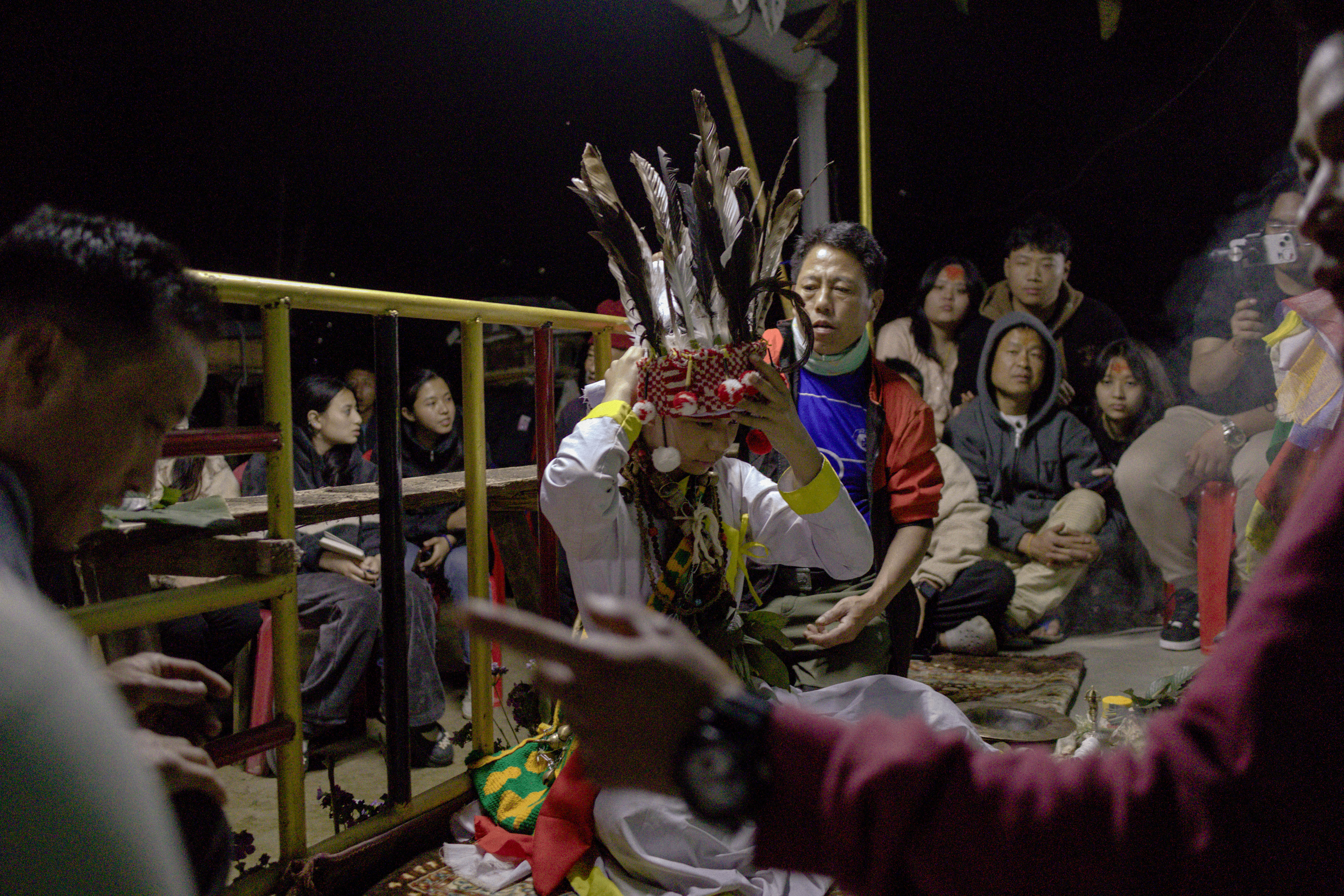
Furthermore, it might have been his closeness to Hinduism as he says he'd been very religiously inclined; he would save up his pocket money to buy offerings for pujas, which catalyzed him accepting his spiritual calling. Many people in his neighborhood remarked that there was something special about him. He also adds that after the dreams he also had sensations coursing through his body whenever he was in close proximity of the sound of cymbals and drums during religious gatherings and Chinta rituals, a sign that the ancestors were calling on him to take his role as a Mangpa (Shaman). One such incident Aryap recalls was when he had visited a Shaman in Ghoom with his aunt, had told him that a God (Devta) resides within him and advised him to revere the God within him. The Shaman further reveal to him that his great-grandfather who lived seven decades ago was also a very powerful Shaman of his times, and those spiritual powers are now being passed down to Aryap. After returning from Ghoom that evening, Aryap went on to perform his usual prayers. He stepped into his worship space, known in his culture as the Kul or Chula Kotha. At the heart of this sacred space stood the Samkhalung—the house altar. As he entered the Samkhalung and began lighting the fire between the three hearth stones (ritual stones central to the altar), something unusual began to happen.
As the flames started to rise, Aryap began to shiver uncontrollably. His hands trembled, his body felt heavy, and an overwhelming energy seemed to surge through him. Alarmed by the sudden change in him, his parents rushed into the room, filled with concern and confusion.
After a while, as the trembling subsided and Aryap regained his composure, he realized something profound, it was as though a presence had awakened within him. He remembered what the shaman in Ghoom had told him: that his great-grandfather, a powerful shaman, had once tended to the same sacred stones.The divine Devta , Aryap confesses reveald to him what it was and why it had come to him. The devta revealed that it had been in his family for seven generations and was the one who his great grandfather tended to , has now come to Aryap. From that day on, Aryap approached the Samkhalung with deeper reverence. He no longer saw himself as just a devotee, but as a vessel a continuation of something ancient. After that, he began discovering items belonging to his Koppa;various stones , trishul, malas etc.
He received teachings from his guru also known as the Mangpa. As they have no written scriptures, all teachings are passed down through word of mouth from teacher to student. This process helps with the promulgation of the ancient Rai folklore (termed as ‘Sili’). After the completion of this, the tradition of ‘Devati' is followed which as Aryap suggests is similar to a graduation ceremony where the student crosses the threshold and gets initiated into a Mangpa(Shaman).
On a Full Moon day (purnima) Aryap talks about he found one of the Sila at his Mangkhim toppled , as he tried to put it upright, it wouldn’t budge, in a dream it was revealed to him that spot was reserved for something sacred. After coming back from school the next day, Aryap discovered that a myriad of stones had uncovered themselves from the earth on that particular spot , he also tells of spontaneous sprouts of hot water ebbing from that area and to this day it is revered by his villagers and is believed to fulfill wishes.
When asked about his daily rituals Aryap walked me through how he spends his day as a Mangpa (Shaman) and a school going boy. His morning routine is mostly dedicated to school and studies , his evenings however are spent performing Chinta rituals. On evenings, when he's not engaged in performing rituals, he's mostly on his ‘Mangkim' (shrine /alter) where people visit him for wadding off evil eye, cure hexes and/or for healing ailments that can’t be healed by medical sciences.
Talking about his premonitions and finding things for his rituals, Aryap tells us that the devta visits him through dreams and visions , who reveals to him about sacred objects , like the one-faced rudraksh, a shivling/conch shaped stone , and a snake engraved stone.
Aryap when asked about the importance of the Chinta in the Rai community explains The meaning of the word ‘Chinta’ in the Nepali lexicon varies accordingly to its usages in different communities. The Chinta ritual holds a very significant role religiously as well as culturally in the Rai community.
The Chinta ritual is mainly an after death ritual. It is held for the salvation of the deceased’s soul, the soul safety during its journey to the afterworld and also for the well-being of the community. This ritual also provides a space for families, friends and the community to pay respects to the deceased . This ritual provides space for the family ,friends and the community to pay respects to the deceased. Before performing any Chinta ,Aryap says that he has to do a separate puja at his house very nicely , so as to ask his devta and ancestor for a fruitful Chinta.
The ritual invokes the deceased’s soul through the meat of a pig , it then enters the body of the shaman putting him/her in a trance. This way Aryap can talk and act in the same manner the deceased used to act. This trace is replicated in folk songs and dances indigenous to the Rai community. The Chinta ritual facilitates communal bonding says Aryap.
Talking about the most difficult Chinta he had to perform , Aryap recalls the one in a village in Ging where the habitants had been facing hauntings. After rituals he recalls uncovering bloodied bones from the grounds , which he terms as ‘Siha’. He associates these hauntings with the souls not being able to go to the after life , and these cases he says had mostly been associated with untimely deaths like suicides , accidents , etc.
While mediating with these spirits he says the atmosphere becomes very somber, but it gives the deceased’s family members some solace and reassurance that their loved one has now passed peacefully to the afterworld. He also gave some insight on sacred/essential objects crutial to carryout the Chinta. One such item is the Chindo a vessel which is filled with na nang and wayang and wa(water) enclosed with banana leaves. Deer Antler to drum a brass plate for activating energies. The betchuk or ginger Aryap explains is the most essential part of Chinta which tells the Mangpa about positive and negative outcomes while the thurmi helps the Mangpa cure hexes and repell malevolent sprits during Chinta.
One integral query that I wanted him to enlighten me on was the differentiation between a Mangpa, Jhakri and Fedengba, whether the difference between these terms were merely dialectic or they had difference in the rituals practiced.
To which he replied that the Mangpa/Bijuwa are indigenous to the Rai community but are known by different names according to the various sub-tribes within the Rai Community [E.g Mangpa/Bijwa – Nacchung in the Chamling dialect, Rawenhang in the Bantawa dialect]. Here, the difference is only dialectic but the functions are the same. However, the Jhakri are indigenous to the Mangar and Chettri communities and the Fedengba to the Subba Community and their rituals vary accordingly.
Aryap tells me that there is rarely any time for him to spend with his family as he gets calls from places out of Darjeeling, like Jharkhand , Kolkata etc, to perform rituals . Furthermore he explains that shamanism does not have any particular religion and he gets called to perform rituals and cure hexes by people of various religious backgrounds . these often times clash with his sleep schedule leading to sleep deprivation. When asked about his academic life , he says that he tries his best to balance his academics along with practicing shamanism but he cannot do everything out of his own will as he also has to listen to his devta as they need to be tended carefully. The school too grants him leave whenever he has to travel for his rituals. Talking about the “Devta” Aryap expounds that the Devta has no particular religion. The Devta is always on the move and due to contaminated spaces in the modern day and due to contaminated spaces in the modern age the Devta says aryap and needs a pure soul/body to enter into. He feels grateful to give back to his community and help them. Aryap also wants to help people understand the intricacies of Shamanism in the Rai community. He believes that there has been a vast difference in the way Shamanism has been practiced in present time to the Shamanism practiced in the past.
The older Mangpas believes Aryap are much more powerful , the new generation Mangpas he believes are comparatively less powerful and arent much focused on their craft.
Aryap talked about how important it has become to preserve Rai Shamanism as it has been declining steadily , due to modernization , lack of enthusiasm amongst the younger generation to learn about their culture and refusing to accept their calling to shamanhood. He believes that Bijwas might cease to exist after 2060.He also brings light to the fact that due to modernization and the Sciences people have started labelling shamanism as heathen and superstitious , accusing it of animal cruelty . He explains that these rituals have been an integral part of every Rai household since times immemorial. Concluding he also brings to light the fact that every Mangpa/Mangma has their own way of practicing and no one should copy that, it cant be copied. Respect should always be given to the Mangpa/Mangma. He says that everyone should keep their egos in check as everyone has to die eventually, nothing is permanent.
During a short conversation with Aryap's Grandfather who he calls Koppa, he tells us that he feels proud of his grandson for carrying this sacred thing forward. He says that the Kul is being taken care of by him and his grandson. His parents too expect him to do great things in the future and believe he balances his academics with his shamanhood.
Aryap has been a practicing Mangpa(Shaman) in his community for four years . At the age of fifteen , he believes it is his duty to uphold the values of his culture and safeguarding it.